


You feel it almost every evening. The day slipped by, the to-do list barely moved, and the goals you care about most stayed exactly where they were. Learning how to use time on your favor is not about squeezing more tasks into your schedule. It is about making the hours you already have work for your finances, your peace of mind, and the future you are actually building. This guide gives you tested strategies to do exactly that, starting today.
Key Takeaways
| Point | Details |
|---|---|
| Start with a time audit | Track your time in 30-minute blocks for one week to expose hidden drains before changing anything. |
| Prioritize by value, not mood | Use frameworks like the Eisenhower Matrix to focus on what actually moves your goals forward. |
| Treat time blocks as appointments | Protect your most productive hours like a meeting you cannot cancel. |
| Mix alive time into your day | Replace passive, low-awareness moments with intentional activity that grows your finances or well-being. |
| Review and adjust regularly | No single strategy works forever. Revisit your approach weekly and adapt as your needs shift. |
How to use time on your favor: start with a time audit
Before you can make time work for you, you have to know where it is going right now. Most people have a rough idea, but the truth is almost always surprising once you see it in writing.
Research confirms that approximately 60% of professional working hours are consumed by low-value tasks. That is more than half your day spent on things that barely register on your goal progress. Emails, interruptions, unfocused scrolling, reactive meetings. They pile up quietly.
The fix is a one-week time audit conducted in 30-minute increments. You do not need fancy software. A paper log or a free tool like Toggl works perfectly. Every 30 minutes, jot down what you actually did. Be honest. At the end of the week, group your entries into categories: deep work, communication, admin, rest, and distraction.
What you will find is a pattern, and tracking your time for even a single week reveals the biggest leaks and shows you exactly where to focus improvements. That awareness alone creates momentum because you stop guessing and start deciding.
Here is a simple framework for categorizing what you find:
| Category | Examples | Value level |
|---|---|---|
| Deep work | Writing, planning, skill-building | High |
| Communication | Emails, meetings, calls | Medium |
| Admin | Filing, scheduling, errands | Low to medium |
| Distraction | Social media, random browsing | Low |
| Rest | Sleep, breaks, exercise | High |
Pro Tip: Set a gentle phone alarm every 30 minutes during your audit week. When it goes off, write down exactly what you are doing before you move on. Consistency makes the data actually useful.
Many people skip the audit step and jump straight into productivity systems. That almost always leads to frustration because you are building on an unknown foundation. Starting with an audit before adopting complex systems is what separates people who actually change their habits from those who just buy new planners.
Goal setting and prioritization that actually works
Once you see where your time goes, the next step is deciding where you want it to go. This means setting goals that are specific enough to act on and then ranking them honestly.

SMART goals (Specific, Measurable, Achievable, Relevant, Time-bound) are the standard for a reason. They convert vague wishes like "get better with money" into something real: "Save $200 per month by cutting dining out to twice a week for the next three months." That specificity matters because vague goals produce vague effort.
Breaking larger goals into smaller timed segments is equally powerful. Small timed segments of 30 minutes overcome procrastination and create consistent progress without burnout. Think of it like Dory in Finding Nemo swimming through the ocean. She does not think about the whole Pacific Ocean. She just keeps swimming, one stretch at a time.
Prioritization is where most people lose the plot. The Eisenhower Matrix is a tool that has stood the test of time because it forces you to separate urgency from importance:
- Urgent and important: Do it now. These are real priorities.
- Important but not urgent: Schedule these. This is where your life goals live.
- Urgent but not important: Delegate or batch these when possible.
- Neither urgent nor important: Cut them. They are stealing your alive time.
The goal is to protect your "important but not urgent" category. That is where debt repayment planning, learning a new skill, and mental health practices tend to sit. They are easy to delay indefinitely because nothing catches fire if you skip them today. But they are also the work that actually changes your life trajectory.
Values-based choices over mood-based reactions reduce decision fatigue and increase alignment with your real goals. When you plan from your values instead of your inbox, everything shifts.
Pro Tip: At the end of each day, write down your three priorities for tomorrow. Doing this the night before removes the morning mental scramble and gets you moving on purpose instead of momentum.
Proven execution strategies for daily time use
Knowing your priorities is one thing. Protecting the time to act on them is another. Here are the methods that consistently work, ranked by how much structure they require.
-
Time blocking. Assign specific tasks to specific time windows on your calendar. Monday from 9 to 10 a.m. is for financial review. Tuesday from 7 to 8 a.m. is for exercise. These are not suggestions. Treating time blocks as non-negotiable appointments, especially protecting the first 60 to 90 minutes of your day for your most critical task before email or messages, is what separates consistent performers from reactive ones.
-
The Pomodoro Technique. Work in focused 25-minute sprints followed by a 5-minute break. After four sprints, take a longer 20-minute break. This method is especially useful if you struggle to sustain focus or tend to feel overwhelmed by large tasks. It turns a 3-hour project into a series of very manageable sprints.
-
Task batching. Group similar tasks together and handle them in a single block. Respond to all messages at 10 a.m. and 4 p.m. rather than checking every 15 minutes. Batching communications is a direct response to the fact that 60% of workers lack focused windows because of constant email checking. Batching gives you back control.
-
Micro-deadlines. Give each task a specific finish time, not just a start time. "I will draft this budget outline by 11 a.m." is far more powerful than "I will work on the budget this morning." The constraint creates focus.
-
Audio learning during transition time. Commutes, chores, and workouts are prime alive time. Using audio content for learning during these moments turns otherwise passive minutes into growth without adding extra hours to your day.
Pro Tip: Schedule your highest-impact task first thing in the morning before you open any apps or check any notifications. Your brain's executive function is strongest early in the day, and protecting that window is one of the highest-return time optimization tips you will ever use.
A meta-analysis of 158 studies confirms that structured time management training improves both performance and well-being when the methods are matched to an individual's actual challenges, whether that is procrastination, overload, or distraction. Pick what fits your situation, not what sounds impressive.
Tracking progress and avoiding common pitfalls
You have your audit data, your priorities, and your execution methods. Now comes the part most people skip: actually checking whether any of it is working.
Set a weekly review. Fifteen minutes on Sunday evening or Friday afternoon. Look at what you planned and what you actually did. Not to judge yourself, but to get smarter. Here is what to check during that review:
- Did your time blocks hold, or did something repeatedly push them off? If so, that something needs addressing directly.
- Are you making progress on your "important but not urgent" goals, or are they getting buried again?
- Which technique is actually reducing stress and increasing output? Double down on that one.
- Are you overcommitting? A full calendar is not a productive calendar. Leave buffer time or everything cascades.
The most common mistake people make is combining overlapping techniques. Using two similar focus timers, for example, creates confusion rather than clarity. Pairing complementary methods like prioritization frameworks with scheduling tools produces far better results than stacking redundant systems.
External accountability also helps enormously. Share your weekly goals with someone you trust. Or post them in a community where others are working on similar challenges. The simple act of saying "here is what I plan to do" increases follow-through significantly.
Switching strategies when one stops working is not failure. It is intelligence. Time management is an executive brain function, and your needs will shift as your life circumstances change. Staying flexible is part of the strategy.
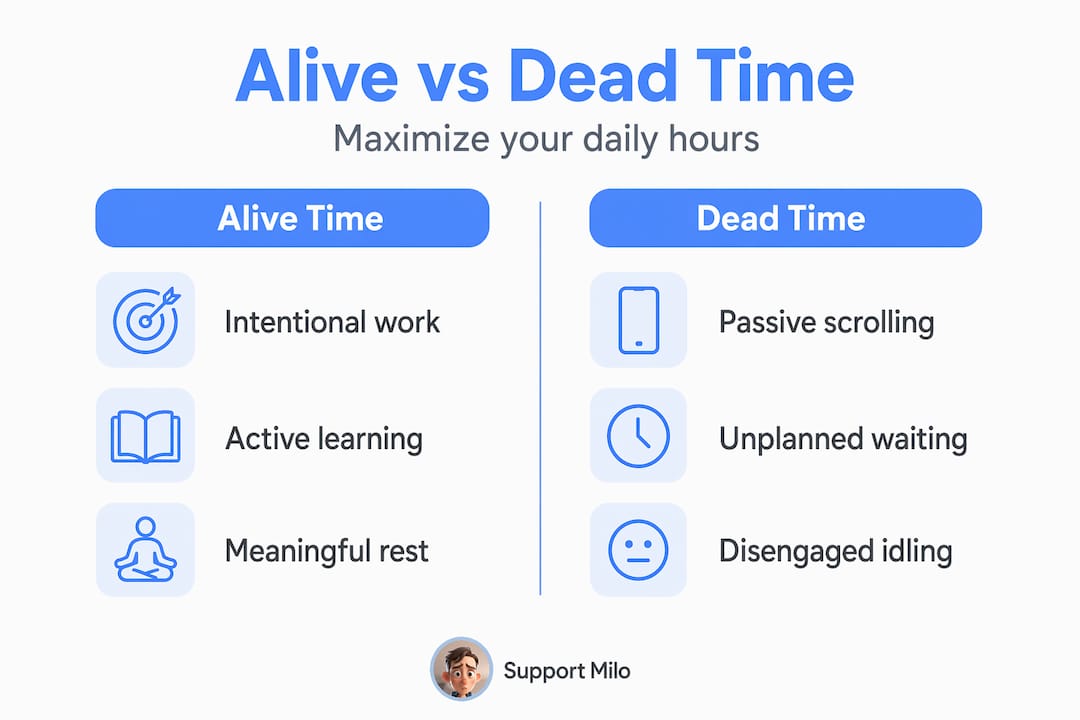
Alive time versus dead time
There is a concept that does not get nearly enough attention in conversations about how to make the most of your time: the difference between alive time and dead time.
Dead time is passive waiting. Scrolling without intention. Sitting in traffic with your mind blank. Watching a third episode because you cannot decide to stop. Research suggests that up to 20% of daily time is lost to this kind of passive drift.
Alive time is intentional, growth-focused activity. It does not have to be intense. Reading 10 pages about personal finance on your lunch break. Listening to a podcast about debt management during your commute. Writing three things you are grateful for before bed. These moments add up across a week into something meaningful.
"The difference between who you are and who you want to be is what you do with the hours in between."
This does not mean you should never rest. Rest is alive time when it is intentional. A nap you choose to take because you recognize you are depleted is recovery. Zoning out because you feel too overwhelmed to decide what to do next is dead time in disguise.
Look at your time audit results. Identify your biggest pockets of dead time and ask honestly: what is one alive-time activity that could replace even 20 minutes of that each day? A small shift, practiced consistently, is one of the most underrated strategies for effective time use you will find.
My honest take on turning time around
I have worked with people navigating financial stress and the anxiety that comes with feeling behind. One thing I have learned is that time pressure makes everything harder and that it is almost always rooted in a mismatch between values and how hours are actually spent.
When I first started exploring time audits myself, I was genuinely shocked. I thought I was working hard. The data showed I was busy, not productive. There is a real difference, and most people do not realize which side they are on until they look.
The misconception I see most often is that productivity means doing more. It does not. The people who make the most meaningful progress are ruthless about doing fewer things well. They protect their mornings. They batch their communication. They say no to things that do not serve their real goals.
If you are dealing with debt, trying to rebuild financial health, or simply trying to feel less overwhelmed, start small. One week of time tracking. Three clear priorities per day. That is it. You do not need a perfect system. You need honest data and a willingness to act on it.
Time does not favor the busiest person. It favors the most intentional one. And every small step you take toward that intention is worth celebrating.
— Milo
How Support-milo supports your progress
If managing your time feels harder when debt or financial stress is weighing on you, you are not alone. Many people find that the mental load of financial struggle makes it nearly impossible to focus on anything else. That is exactly why Support-milo exists.
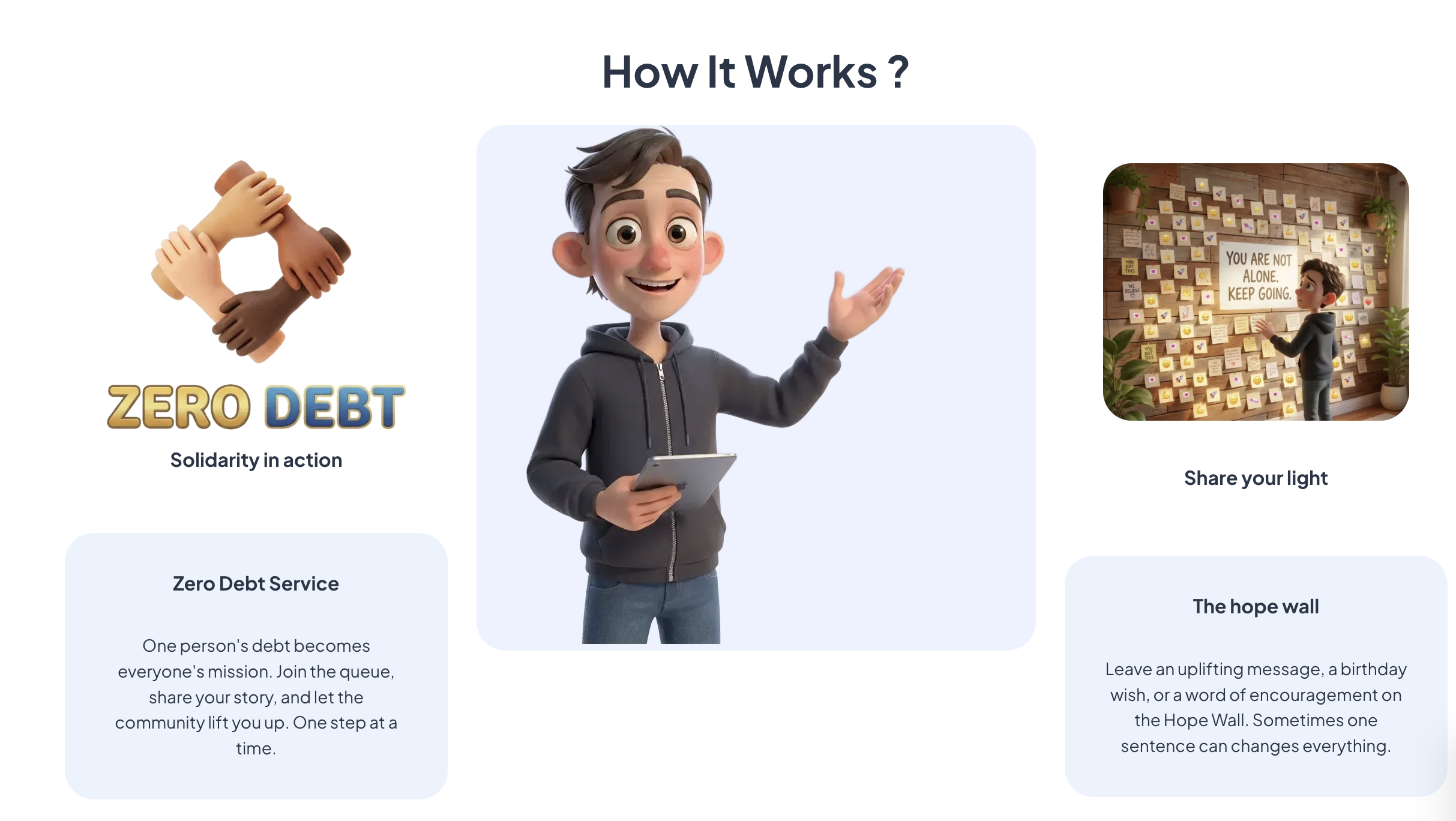
Support-milo is a community-driven platform built for people who are working through financial and behavioral challenges together. Whether you are tracking debt repayment, looking for community encouragement on the Hope Wall, or exploring enterprise well-being support for yourself or your team, there are real resources here. You can also explore the Support-milo blog for more practical guidance on financial recovery and mental well-being. Progress is possible, and you do not have to make it alone.
If clearing debt is part of your goal, the zero-debt program is a meaningful place to start combining your time management efforts with real financial action.
FAQ
What does it mean to use time on your favor?
Using time on your favor means making intentional choices about how you spend your hours so they actively support your goals, finances, and well-being rather than passing by without progress.
How long does a time audit take?
A time audit takes one week of tracking your activities in 30-minute increments. The investment is small, and the clarity it creates is the foundation for every other time management improvement you make.
What is the best time management technique for beginners?
Time blocking is the most accessible starting point. Assign your top priority to a specific morning window and treat it as a non-negotiable appointment. Build from there once the habit feels natural.
How do I prioritize time when everything feels urgent?
Use the Eisenhower Matrix to separate what is truly important from what is simply loud. Most urgent tasks are not actually important, and recognizing that distinction frees up time for the work that genuinely moves your life forward.
Can better time management improve mental health?
Yes. Structured time management has been shown in a meta-analysis of 158 studies to improve both performance and well-being, particularly when methods are matched to individual challenges like overload or anxiety.