


You place a bet, you lose, and something shifts inside you. It's not just disappointment. It's a pull, almost physical, urging you to play again. Most people assume this is simply greed or poor self-control. But science tells a very different story. Loss chasing, the compulsion to keep gambling after a loss in order to "win it back," is driven by a powerful mix of brain chemistry, emotional urgency, and deeply ingrained thought patterns. Understanding exactly why this happens is the first step toward breaking free from it.
Table of Contents
- What does loss chasing really mean?
- Three forces that drive loss chasing
- How cravings and urgency override logic
- Why a 'one-size-fits-all' approach fails
- How to interrupt the loss-chasing cycle
- The real roots of loss chasing — and what experts miss
- Find support to stop chasing losses
- Frequently asked questions
Key Takeaways
| Point | Details |
|---|---|
| Loss chasing explained | Chasing losses is fueled by emotional, cognitive, and brain-driven forces, not simply lack of willpower. |
| Science-backed profiles | Different people chase losses for different reasons, and understanding your personal pattern is key. |
| Warning signs are measurable | Loss chasing can be tracked by changes in bet size, speed, and urgency, offering a chance for early intervention. |
| One-size-fits-all fails | Unique emotional and cognitive drivers require personalized support and tools to break the cycle. |
| Effective strategies exist | You can interrupt loss chasing with targeted techniques, tools, and supportive resources designed for real-world use. |
What does loss chasing really mean?
Loss chasing is not just playing again after you lose. It's a specific behavioral pattern where the motivation to continue gambling is directly tied to recovering previous losses. That distinction matters. A recreational player might gamble again next week. A person caught in loss chasing feels they must play again right now, driven by an urgent need to "undo" what just happened.
This behavior is different from regular or social gambling in a key way: it's reactive. The loss itself becomes the trigger. And once that trigger fires, a chain of events begins that has very little to do with rational decision-making.
"Loss chasing in gambling is maintained by reinforcement processes linked to cognitive distortions (e.g., illusion of control/near-misses) and by strong emotional reactions to loss that make continuing feel 'necessary.'" — The near-miss effect
Cognitive distortions (mistaken beliefs your brain accepts as true) play a big role here. Common ones include:
- Illusion of control: Believing you can influence a random outcome through skill or ritual.
- Gambler's fallacy: Thinking a win is "due" because you've lost several times in a row.
- Near-miss thinking: Interpreting almost-wins as signs that a real win is just around the corner.
- Magical thinking: Believing that changing your bet amount or timing will change your luck.
These distortions don't feel like errors. They feel like logic. That's what makes them so dangerous. And if you've ever found yourself thinking "I'm so close, I just need one more round," you've experienced this firsthand. You're not alone, and you're not weak. Your brain is doing exactly what it was wired to do under these conditions. Exploring support programs for gambling can help you understand these patterns and start building healthier ones.
Three forces that drive loss chasing
Understanding what loss chasing is sets the stage for exploring what truly causes and fuels it. Research points to three core forces working together, and when all three hit at once, the urge to keep gambling can feel almost impossible to resist.
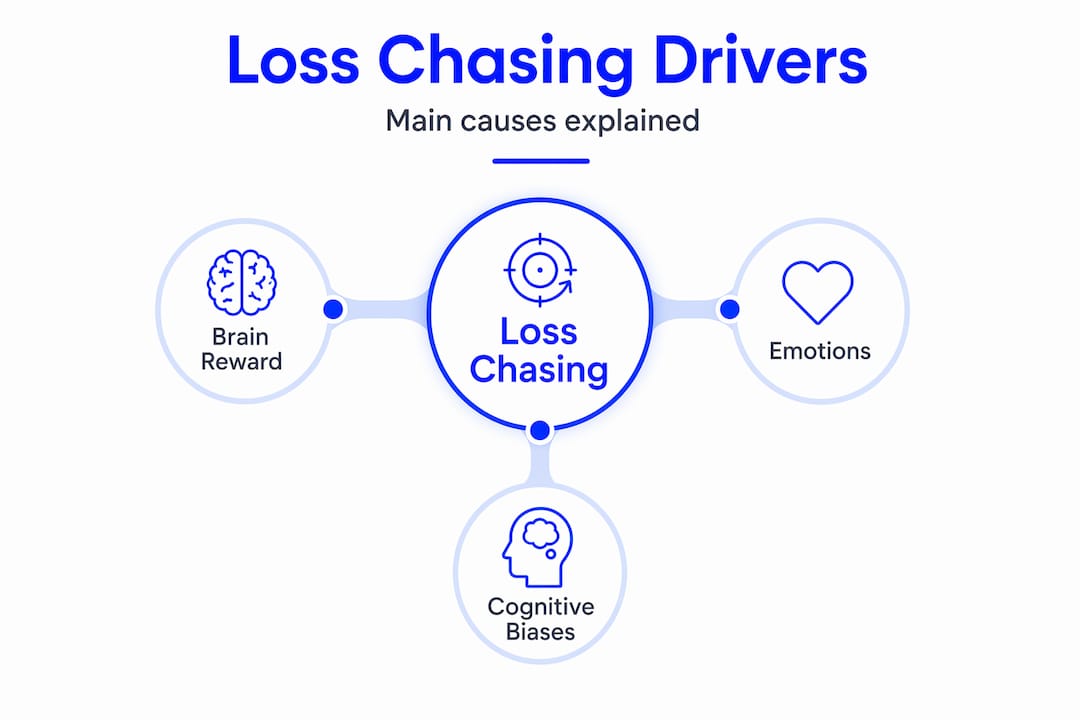
| Force | What it is | How it fuels loss chasing |
|---|---|---|
| 🧠 Brain/reward learning | Dopamine-driven responses shaped by game design | Near-misses activate reward circuits, pushing you to keep playing |
| 💥 Emotional urgency | Craving, distress, and urgency after a loss | Loss triggers a strong emotional state that demands relief |
| 🔄 Cognitive errors | Irrational beliefs about control and probability | Distorted thinking makes continuing feel rational and necessary |
Research confirms that loss chasing is best understood as "an interaction between (1) brain/reward learning shaped by game design (e.g., near-misses), (2) emotional urgency/craving after loss, and (3) decision/logic errors (irrational beliefs about control/probability), which together produce the urge to 'fix' the loss by continuing."
What makes near-misses particularly powerful is that they are often engineered. Many gambling games are specifically designed to produce frequent near-miss outcomes. These almost-wins activate the same reward pathways in your brain as actual wins, flooding your system with dopamine and making you feel like success is just one more spin or bet away. It's not luck that you feel that way. It's design.
And real betting data confirms these patterns are measurable. Researchers can track loss chasing through changes in bet size, odds selection, and the time between bets, showing that this isn't just a feeling. It's a behavioral shift that shows up clearly in the data.
Pro Tip: Ask yourself which of the three forces feels strongest for you. Is it the emotional pull? The belief that you're "due" a win? Or the almost-physical craving to play again? Identifying your primary driver helps you choose the most effective strategy for your situation.
Connecting with emotional support for gamblers can help you start naming these forces in your own experience, which is a powerful first step.
How cravings and urgency override logic
After laying out the three drivers, it's worth zooming in on emotional urgency, because this is often the force that catches people most off guard. You might know the odds are against you. You might know chasing losses rarely works. And yet you still feel compelled to play. Why?
Because craving bypasses logic. When a loss hits, your emotional brain fires up faster than your rational brain can respond. Here's how that escalation typically unfolds:
- The loss occurs. Your brain registers it as a threat, not just disappointment.
- Distress spikes. Anxiety, frustration, or shame floods in almost immediately.
- Craving activates. The urge to "fix" the situation rises sharply, often within seconds.
- Rational thinking weakens. The prefrontal cortex (the part of your brain responsible for planning and judgment) gets overridden by the emotional response.
- Behavior shifts. You start betting faster, increasing stakes, or choosing riskier odds, often without consciously deciding to.
- The cycle deepens. Each subsequent loss intensifies the craving, making it harder to stop.
📊 Statistic callout: A study by Cosenza et al. (2024) involving 166 Italian adults who gambled at least weekly found that cravings were the strongest motivator for chasing losses, outpacing other factors like financial pressure or social influence. A separate study by Chen et al. (2022) tracking 2,713 online gamblers found that the speed of play measurably increased after losses, even when session duration and bet sizes varied.
This is important because it shows that loss chasing isn't a choice made in a calm, rational moment. It's a response to an emotional state that your brain is desperately trying to escape. Using tools for recognizing gambling escalation can help you catch these warning signs before the cycle fully takes hold.

Why a 'one-size-fits-all' approach fails
Having explored the force of emotions, it's important to recognize that not all loss chasing looks or feels the same. Two people can both chase losses and yet be driven by completely different forces. This is why generic advice often falls short.
Research clearly distinguishes between two broad subtypes:
| Subtype | Primary driver | What it feels like | Best approach |
|---|---|---|---|
| Emotion-driven | Craving, distress, urgency | Overwhelming urge, panic, emotional flooding | Emotional regulation, craving interruption tools |
| Belief-driven | Cognitive distortions, faulty logic | Feeling "due" a win, overconfidence in patterns | Cognitive restructuring, education about probability |
Most people are a mix of both, but one tends to dominate. And studies confirm that cognitive and emotional subtypes respond differently to support, meaning a plan built around challenging beliefs may not help someone whose primary driver is emotional craving, and vice versa.
Recognizing your subtype is genuinely empowering. It shifts the question from "why can't I just stop?" to "what does my brain specifically need right now?" That's a much more useful and compassionate starting point.
Here are some practical ways support systems can adapt to different needs:
- For emotion-driven loss chasing: Mindfulness techniques, breathing exercises, and immediate access to a support person or community during high-risk moments.
- For belief-driven loss chasing: Journaling about outcomes, probability education, and working with a counselor to challenge distorted thinking patterns.
- For mixed profiles: A layered approach that addresses both emotional regulation and cognitive restructuring at the same time.
- For everyone: Community connection, because isolation tends to worsen both emotional and belief-driven patterns.
Exploring tailored support for gamblers can help you figure out which approach fits your specific experience, rather than trying to force yourself into a template that wasn't built for you.
How to interrupt the loss-chasing cycle
Having identified why one-size-fits-all solutions don't work, let's focus on what actually does. The good news is that loss chasing is measurable, which means it's also interruptible. You don't have to wait until you've hit rock bottom to take action.
Here's a step-by-step guide for recognizing early warning signs and stepping in before the cycle takes over:
- Learn your personal warning signs. Do you start betting faster? Do your stakes creep up? Do you feel a tightness in your chest or a racing mind? These are your signals.
- Name what you're feeling. Saying "I'm feeling the urge to chase" out loud or writing it down creates a tiny pause between the craving and the action.
- Create physical distance. Step away from your device or location. Even five minutes can reduce craving intensity significantly.
- Use a pre-committed block. Set up blocking tools before a high-risk moment, not during one. This is critical.
- Reach out to someone. A message to a support community, a friend, or a counselor can interrupt the isolation that feeds loss chasing.
- Reflect after the moment passes. Understanding what triggered the episode helps you build better defenses for next time.
Pro Tip: Many online platforms now offer self-exclusion and session limit tools. Set these up when you're calm, not in the middle of a craving. Research shows that recovery strategies are most effective when they focus on blocking access during that high-risk window, not only on changing beliefs over time.
Additional resources and strategies that support lasting change include:
- Community-based support where others understand what you're going through
- Debt tracking tools that make the financial impact visible and motivating to address
- Peer stories that normalize the struggle and celebrate progress
- Digital blocking tools for high-risk gambling moments that remove the option to act on a craving
Explore blocking tools for high-risk gambling to find options that fit your lifestyle and risk profile.
The real roots of loss chasing — and what experts miss
Here's something that most standard advice gets wrong: telling someone to "just set a limit" or "walk away" assumes that loss chasing is a simple behavior problem. It's not. And treating it like one often makes people feel worse, not better.
When you're in the grip of a craving, willpower alone is rarely enough. Not because you're weak, but because the emotional and neurological forces at work are genuinely powerful. Games are often engineered to trigger these responses. Near-misses, variable reward schedules, rapid play speeds, these are not accidents. They are features, and they exploit the same brain systems that drive other forms of compulsive behavior.
What we've seen is that shame-based approaches, the ones that lean on "you should know better," tend to push people deeper into isolation. And isolation makes everything worse. The most effective recovery combines three things: behavioral tools (like blocking access during high-risk windows), emotional support (like community connection and craving management), and cognitive work (like gently challenging the beliefs that make chasing feel logical).
None of these work as well alone as they do together. And none of them work at all if the person doesn't feel safe enough to be honest about what's happening. That's why holistic support approaches that treat the whole person, not just the behavior, tend to produce the most meaningful and lasting change.
The uncomfortable truth is that loss chasing is not a moral failing. It's a human response to a system that was designed to create exactly this kind of response. Recognizing that doesn't remove your responsibility to seek help. But it does remove the shame that so often gets in the way of doing so.
Find support to stop chasing losses
You've just learned that loss chasing isn't about weakness or bad choices. It's about brain chemistry, emotional urgency, and thought patterns that can be understood and changed. That's genuinely hopeful news.
Support Milo is built for exactly this moment. Whether you're in the middle of a difficult stretch or just starting to recognize the patterns, Support Milo offers a warm, community-driven space where you can share your story, track your progress, and connect with others who truly get it. From the Hope Wall to real-time debt tracking, every feature is designed to replace isolation with solidarity. Get support today and take your first step toward a recovery that actually fits you. You can also explore Zero Debt recovery tools to start addressing the financial side of your journey alongside the emotional one.
Frequently asked questions
Is chasing losses a sign of gambling addiction?
Yes, loss chasing is widely recognized as a behavioral marker of gambling addiction and risk escalation. Research confirms it shows up in measurable, in-the-moment patterns that signal worsening trajectories.
Why do I feel an overwhelming urge to keep gambling after a loss?
Emotional cravings and changes in brain chemistry after a loss fuel the urge to keep playing. Near-miss outcomes can trigger reward-system activation and stronger motivation to continue than clean wins do.
Can loss chasing be measured and tracked?
Yes, modern research tracks loss chasing in real time using changes in bet sizes, odds, and timing. Behavioral patterns in real betting data clearly relate to worsening loss trajectories.
Are some people more likely to chase losses than others?
Yes, gamblers differ in whether emotion, craving, or mistaken beliefs are driving their behavior. Studies distinguish cognitive and emotional subtypes, meaning your specific profile shapes which strategies will work best for you.
What is the best first step to stop chasing losses?
The best first step is to recognize your unique triggers and use strategic support or digital tools that block play during risky moments. Recovery strategies are most powerful when they target that high-risk window directly, not just long-term belief change.