


When someone you care about is hiding gambling debts, your first instinct might be to feel betrayed. But understanding why loved ones hide gambling debts goes far deeper than simple dishonesty. The secrecy is almost never just about money. It's woven through with shame, fear, addiction psychology, and a desperate hope that things will somehow fix themselves before anyone notices. This article walks you through the emotional, psychological, financial, and relational layers of gambling debt secrecy, so you can move from confusion toward compassion and, eventually, toward real solutions.
Table of Contents
- Key Takeaways
- Why loved ones hide gambling debts: the emotional truth
- The financial risks of hidden gambling debts
- How hidden gambling debts damage relationships
- Signs your loved one may be hiding gambling debts
- Coping and supporting a loved one through this
- My perspective on what actually helps
- You don't have to face this alone
- FAQ
Key Takeaways
| Point | Details |
|---|---|
| Shame drives secrecy | Guilt and fear of judgment are the primary reasons people conceal gambling debts from those they love. |
| Debt compounds fast | Hidden gambling debt grows quickly through high-interest credit and missed payments, creating a financial spiral. |
| Relationships pay a heavy price | Trust breaks down, conflict escalates, and families often absorb financial damage they didn't know existed. |
| Early signs are recognizable | Behavioral and financial clues appear early, and spotting them makes intervention far more effective. |
| Recovery requires multiple supports | Lasting healing combines open communication, financial restructuring, professional counseling, and community support. |
Why loved ones hide gambling debts: the emotional truth
Most people assume gambling debt secrecy is a calculated choice. Think of it like Woody from Toy Story hiding his fear of being replaced. It looks like dishonesty on the surface, but underneath there's a storm of emotion driving every decision. The same is true for someone hiding a gambling problem.
Shame is the biggest driver. Gambling disorder carries a social stigma that makes people feel fundamentally broken, not just financially irresponsible. That shame creates a wall of silence long before the debt becomes unmanageable. Admitting the problem feels like admitting a character flaw, not an illness.

Fear of conflict runs a close second. Many people hide debts because they genuinely dread the fallout. They imagine the argument, the tears, the look of disappointment. So they delay. They tell themselves they'll fix it quietly and spare everyone the pain. Understanding gambling addiction makes this clearer: gambling disorder frequently goes undetected in health systems until a financial or relational crisis forces it into the open.
Here are the core emotional and psychological forces at work:
- Shame and guilt. The person knows their behavior conflicts with their values. Hiding it feels like the only way to preserve their self-image and their relationships simultaneously.
- Denial. Addiction rewires the brain's reward system. Many people genuinely believe they are one big win away from erasing the problem entirely.
- Fear of judgment. From partners, parents, siblings, and friends. The anticipated reaction feels worse than the debt itself.
- Psychological compulsion. Gambling disorder is a recognized behavioral addiction. The secrecy is part of the addiction pattern, not a separate moral failing.
- Hope-based avoidance. They believe they can fix it alone. Early financial deceptions like rounding down numbers or temporarily moving money are common starting points before the problem escalates.
Pro Tip: If someone in your life is defensive about money but otherwise warm and open, that specific defensiveness around finances is worth a gentle, private conversation. Defensiveness is often protection, not aggression.
The financial risks of hidden gambling debts
Hidden gambling debt does not stay still. It grows. And the way it grows is what makes it so dangerous for the whole household.
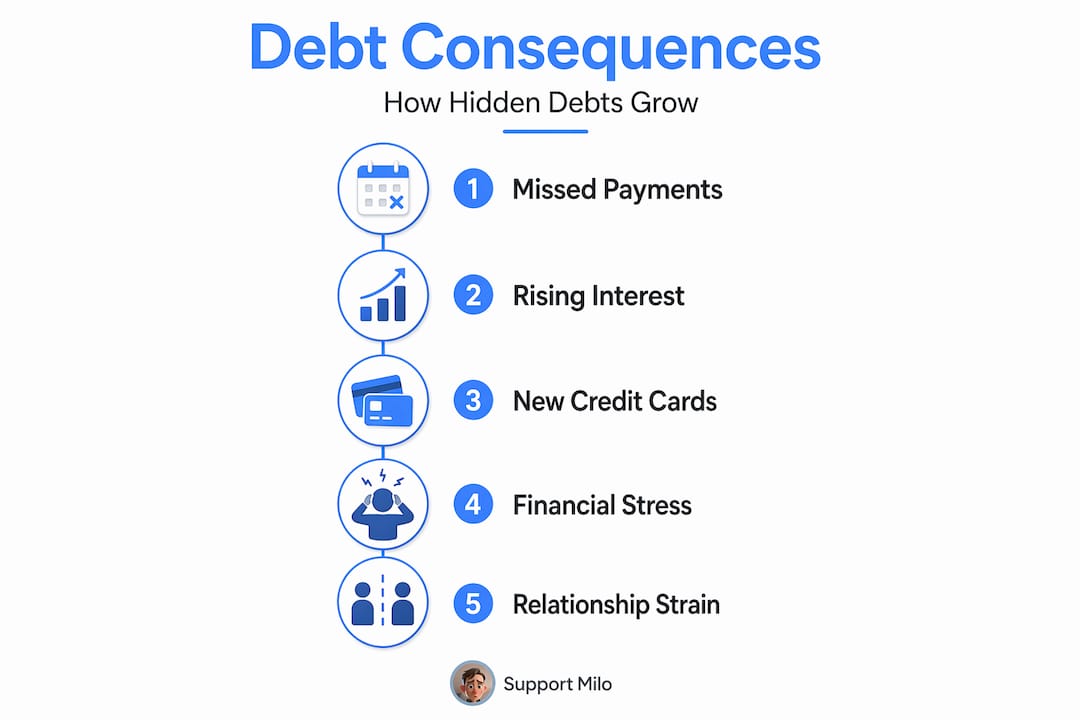
High-interest credit cards are the most common tool people use to fund gambling and hide the evidence. When minimum payments become the only option, interest compounds month after month. One documented case showed a couple taking six months to reduce $17,000 in gambling-related debt while simultaneously financing a $30,000 vehicle. That kind of financial decision-making illustrates how denial and debt can coexist in the same household for a long time.
The table below shows how quickly hidden debt can spiral when interest and concealment combine:
| Starting debt | Monthly interest (avg. 22% APR) | Debt after 12 months (no extra payments) | Debt after 24 months |
|---|---|---|---|
| $5,000 | $92 | $6,168 | $7,613 |
| $15,000 | $275 | $18,504 | $22,838 |
| $30,000 | $550 | $37,008 | $45,676 |
The numbers are sobering. But the legal dimension adds another layer of risk. Gambling debt is unsecured consumer debt and may be dischargeable in bankruptcy, but only if disclosed properly. Gambling losses from the prior 12 months must be listed, and hidden betting accounts treated as undisclosed assets can seriously complicate a bankruptcy case.
"The financial consequences of hidden gambling debts are rarely limited to the gambler. When the truth surfaces, the entire household absorbs the impact." — Support-milo
Forty percent of U.S. adults have kept a financial secret from their partner, with small cash withdrawals sometimes totaling over $100,000 over time. What starts as rounding down a number becomes a pattern. That pattern becomes a crisis.
How hidden gambling debts damage relationships
Money and trust are deeply connected. When gambling debt secrecy is revealed, it rarely feels like just a financial problem to the people affected. It feels like a betrayal of the relationship itself.
Think of Elastigirl from The Incredibles holding everything together while Bob secretly pursues a double life. The emotional weight of being the person who didn't know is crushing. Partners often describe feeling foolish, not just hurt. They question their own judgment and replay every conversation they missed.
Here's what families commonly experience when hidden gambling debts come to light:
- Trust collapse. The discovery triggers a fundamental re-evaluation of the relationship. Everything that happened during the period of secrecy gets reexamined.
- Domestic conflict. Arguments escalate quickly because the issue is no longer just about money. It's about honesty, respect, and the future.
- Mental health strain. Both the person hiding the debt and their loved ones experience anxiety, depression, and emotional exhaustion. Gambling-related financial crises are linked more strongly to emotional pain and family breakdown than to monetary loss alone.
- Protective financial behavior. Families sometimes begin hiding money themselves, creating separate accounts or diverting income to protect household stability.
- Legal consequences in divorce. Courts may classify secret gambling losses as marital asset dissipation, which directly affects divorce settlements. Betting app histories and bank statements become critical evidence.
The relational damage compounds over time, just like the debt itself. Getting ahead of it early is always better than waiting for a crisis to force the conversation.
Signs your loved one may be hiding gambling debts
You don't need to be a financial expert to notice when something is off. The signs tend to appear in behavior long before the numbers become impossible to hide.
Here are the most common indicators to watch for:
- Unexplained cash withdrawals. Regular ATM withdrawals with no clear purpose, especially in round numbers, are a consistent early sign.
- New credit cards or loan accounts. Discovering accounts you didn't know existed is a significant red flag.
- Defensiveness about finances. If routine questions about bills or spending trigger an outsized emotional reaction, that defensiveness is worth noting.
- Lifestyle inconsistency. Spending that doesn't match income, or sudden financial tightness with no clear explanation.
- Emotional withdrawal. Irritability, anxiety, and pulling away from family activities often accompany the stress of managing hidden debt.
- Secretive phone or computer use. Gambling apps and online accounts are easy to hide but leave behavioral traces.
- Missed bills or late notices. When household finances are being diverted, ordinary obligations start slipping.
Hidden gambling debt often starts with seemingly minor financial adjustments that are far easier to address before they compound. Early intervention, even when the signs are subtle, leads to much better outcomes.
Pro Tip: If you notice two or three of these signs together, trust your instincts. A calm, private conversation focused on concern rather than accusation opens more doors than a confrontation does.
Coping and supporting a loved one through this
Finding out that someone you love has been hiding gambling debts is genuinely painful. But how you respond in the early days matters enormously for what comes next.
Here's how to approach it with both compassion and clarity:
- Start with open, non-judgmental dialogue. Lead with concern, not accusation. "I've noticed some things that worry me and I want to understand" lands very differently than "How could you do this?"
- Establish financial transparency. This means shared access to accounts, joint review of statements, and a realistic picture of the household's actual financial position.
- Seek professional support. Debt relief combined with counseling and full financial transparency consistently produces better recovery outcomes than financial fixes alone.
- Get legal and financial advice when needed. If debts are large or divorce is a possibility, understanding your rights early protects you. Courts assess intent, timing, and concealment when evaluating gambling debts.
- Protect your own mental health. Supporting someone through addiction is emotionally exhausting. Boundaries are not a sign of giving up. They are a sign of sustainability.
- Connect with community support. You don't have to carry this alone. Platforms like Support-milo exist specifically to help people in exactly this situation, with real stories, debt tracking, and a community that understands.
Recovery is possible. Many families have moved from crisis to stability. The path requires honesty, patience, and the right support structures.
My perspective on what actually helps
I've seen a lot of families reach out after the secret has already exploded into a full crisis. And the thing that strikes me most is how many of them say, "I noticed something was off months ago, but I didn't want to push." That hesitation is completely understandable. But it almost always makes things harder.
What I've learned is that the small irregularities, the slightly evasive answer, the new card statement, the cash that doesn't add up, those are the moments when intervention is cheapest emotionally and financially. Waiting for certainty before acting is one of the most common and costly mistakes I see.
I also think we underestimate how much the person hiding the debt is suffering. They are not sleeping well. They are not enjoying the life they're pretending to live. They are trapped in a cycle that addiction makes very hard to break alone. That doesn't excuse the secrecy, but it does mean that compassion is a practical tool, not just a moral one. Anger closes doors. Compassion opens them.
The families that recover most fully are the ones who address all three dimensions at once: the emotional wound, the financial reality, and the behavioral addiction. Fixing only the debt without addressing the addiction is like patching one hole in a boat while ignoring the others. Real recovery needs all three.
— Milo
You don't have to face this alone
Discovering that a loved one has been hiding gambling debts can feel overwhelming. You might not know where to start, or even who to talk to. Support-milo was built for exactly this moment. It's a community-driven platform where people share their real stories, track debt repayment progress, and find genuine encouragement from others who have been through the same thing. The Hope Wall, the debt tracking tools, and the zero debt program are all designed to turn a moment of crisis into a starting point for real recovery. You don't need to have all the answers. You just need to take one step. Support-milo walks the rest of the way with you.
FAQ
Why do people hide gambling debts from family?
People hide gambling debts primarily because of shame, fear of conflict, and the psychological grip of addiction. The secrecy is rarely calculated dishonesty. It's usually a combination of denial and the desperate hope of fixing the problem quietly before anyone finds out.
What are the early signs of hidden gambling debt?
Early signs include unexplained cash withdrawals, new credit accounts, defensiveness about finances, and lifestyle inconsistencies that don't match income. Financial infidelity often begins with small deceptions like rounding down numbers or temporarily moving money.
Can gambling debt affect a divorce settlement?
Yes. Courts may classify secret gambling losses as marital asset dissipation, directly affecting how assets and debts are divided. Betting histories and bank statements serve as key evidence in these cases.
How should I confront a loved one about hidden gambling debts?
Approach the conversation privately and lead with concern rather than accusation. Focus on what you've noticed and how you feel, and make clear you want to find a solution together. Professional counseling alongside financial transparency produces the best outcomes.
Is gambling debt dischargeable in bankruptcy?
Gambling debt is unsecured debt and can be dischargeable in bankruptcy if properly disclosed. However, hidden betting accounts treated as undisclosed assets can complicate or jeopardize a bankruptcy case significantly.