


Loss hits you like the floor dropping out from under your feet. Whether you've experienced financial ruin, the end of a relationship, a career collapse, or the crushing weight of addiction recovery, the challenge to rebuild after loses is one of the hardest things a person can face. You might feel frozen, overwhelmed, or convinced that starting over is simply impossible. It isn't. With the right strategies, grounded in real evidence and real compassion, you can move forward after loss and rebuild a life that feels solid and meaningful again. This article gives you the exact roadmap to do that.
Key takeaways
| Point | Details |
|---|---|
| Know what you're facing | Distinguishing a setback from an obstacle helps you direct your energy to the right kind of recovery. |
| Stabilize finances first | Financial desperation clouds judgment; securing basic needs creates the mental safety required for smart decisions. |
| Start smaller than you think | The "Little Victory" strategy builds real psychological momentum through tiny, daily wins. |
| Honor grief before reframing | Rushing to label your loss a "lesson" too soon creates fragile resilience that breaks under future pressure. |
| Steady actions beat big breakthroughs | Small, repeatable habits over a 30-day plan outperform any single moment of insight or motivation. |
How to rebuild after loses: laying the foundation
Before you can do anything practical, you need to understand exactly what you are dealing with. Not all losses are the same, and setbacks vs. obstacles are actually two very different things. A setback knocks you off course without warning. An obstacle is a known challenge standing between you and a goal. Treating a setback like an obstacle wastes emotional energy because they require completely different responses. A setback requires recovery. An obstacle requires adjustment of expectations.
Once you understand which one you are facing, you can stop fighting the wrong battle.
Here are signs that you are ready to begin preparing for rebuilding:
- You can acknowledge what happened, even if you haven't fully processed it yet
- You have some basic financial or emotional stability, even if fragile
- You are open to asking for help or accepting structure from outside yourself
- You recognize that your current state is temporary, not permanent
One critical marker many people overlook is sleep. Sleeping less than 6 or more than 10 hours for more than two weeks is a signal that professional support has become necessary, not optional. If you are deep in that territory, seeking a counselor or therapist is not a detour from recovery. It is the fastest path forward.
Financial stability deserves its own mention here. Financial desperation distorts judgment, which means that trying to rebuild your identity, career, or relationships while you are broke and stressed rarely works. Your first priority is covering basic necessities. Food, shelter, safety. Everything else comes after that foundation is solid.
| Stage | Focus area | Goal |
|---|---|---|
| Week 1 to 2 | Stabilize | Secure basic needs, reduce acute stress |
| Month 1 to 2 | Explore | Identify support systems and assess options |
| Month 2 to 4 | Build | Establish daily habits and small goals |
| Month 4 to 6 | Expand | Grow confidence and pursue larger steps |
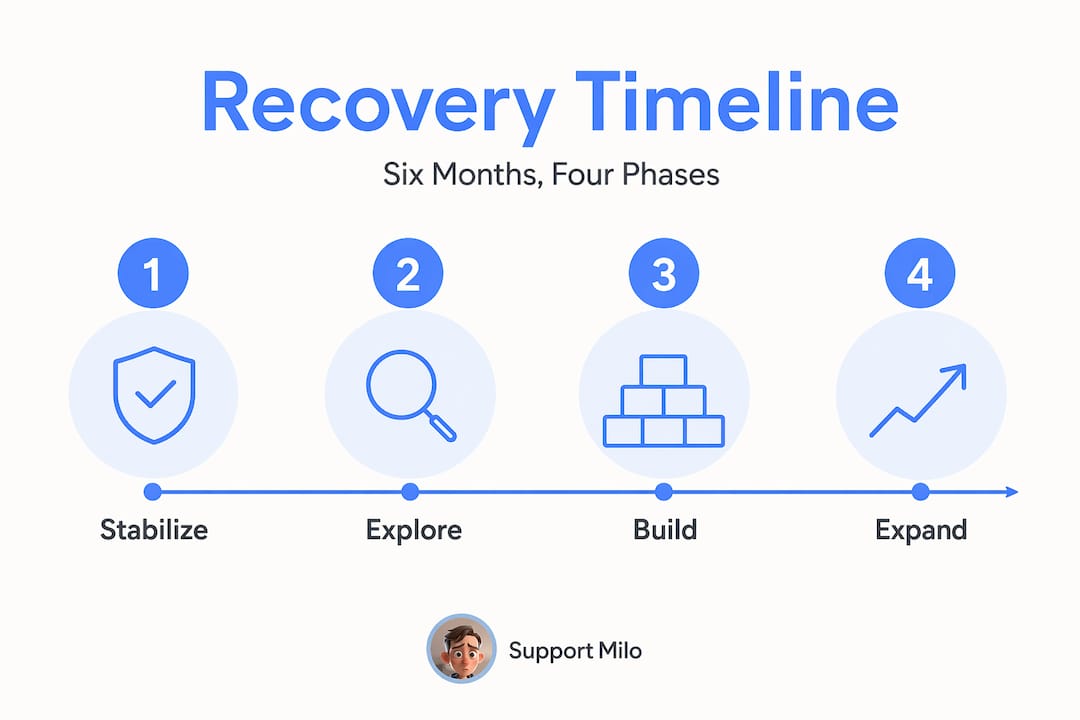
Pro Tip: Structured recovery after major loss typically spans about 6 months across four phases. Knowing this upfront saves you from the trap of expecting to feel "back to normal" in a few weeks.
Self-compassion is a clinical tool here, not a buzzword. Viewing yourself with kindness when you are struggling opens cognitive space for constructive thinking. Without it, self-criticism closes off exactly the possibilities you need to see.
Practical steps to start rebuilding day-to-day life ️
Once your foundation is in place, even partially, you can begin building momentum. The goal at this stage is not transformation. The goal is motion. Small, consistent motion.
Here is a practical sequence to follow:
- Set one tiny goal each morning. The Little Victory strategy is grounded in psychology. Small daily wins build momentum away from self-blame and toward agency. Think: make your bed, drink a glass of water, send one message. Tiny counts.
- Build a loose daily routine. Wake at the same time. Eat real food. Get outside, even briefly. When your internal motivation is at its lowest, external structure carries you. Simple habit plans over 30 days consistently outperform bursts of motivation.
- Use a gratitude journal. Write three things you are grateful for each night. They do not need to be big. "I ate a warm meal" counts. This rewires your attention toward what is still present rather than what is absent.
- Reach out to one person. Isolation accelerates suffering. Connection slows it down. You do not need to explain everything. You just need to be around someone who cares about you, even for an hour.
- Allow yourself to grieve. Recovery is not a sprint away from pain. Grief and rebuilding happen at the same time, not in separate phases. Give yourself permission to feel it alongside taking steps forward.
Pro Tip: If journaling feels overwhelming, try the one-sentence method. Write a single honest sentence about how you feel before bed. Over time, patterns emerge that help you understand your own emotional healing process.
Building a supportive network does not mean surrounding yourself with people who tell you everything is fine. It means finding people who can witness where you actually are and still believe in where you can go. That combination is powerful. Think of Woody from Toy Story: when he felt lost and displaced, it was the steady presence of his community that reminded him who he was. You deserve that same kind of honest, grounded support.
At Support-milo, the community is built exactly around this principle. Real people, real stories, real accountability. You are not alone in this.
Building resilience: shifting mindset and avoiding pitfalls
This is where rebuilding gets more nuanced, and most articles stop too soon.
The most common advice you will hear is "reframe your failure as a lesson." It sounds right. And sometimes it is. But rushing to reframe failure as a lesson before you have fully processed the experience creates fragile resilience. It is the emotional equivalent of putting wallpaper over a crack in the wall. It looks fine until the next storm.
Authentic resilience comes from allowing yourself to feel the full weight of what happened, and then, from that honest place, choosing to keep going anyway.
Here are the key mindset shifts that actually support durable recovery:
- Ask "What can I learn?" not "What is wrong with me?" Positive cognitive reframing shifts your brain from a closed, self-critical loop to an open, growth-oriented one. One question leads to action. The other leads to paralysis.
- Zoom out. Engaging others to reframe personal crises as tensions between ideas rather than personal failings is one of the most underused recovery tools available. Talking to someone who has walked a similar path reminds you that your struggle is human, not uniquely yours.
- Watch for "performing recovery." This is the subtle trap of acting like you are fine for social reasons before you actually feel it. It delays real healing because it cuts off the emotional processing you still need.
- Be specific about self-critical thoughts. When the inner critic fires up, try naming the thought. "There's that voice that says I'll always fail." Naming creates distance. Distance creates choice.
"True strength is not the absence of pain after loss. It is the refusal to let that pain define what comes next."
If self-critical thoughts persist for weeks without relief, or if you notice persistent hopelessness, seeking professional guidance is not weakness. It is the most self-aware thing you can do. Therapy gives you tools that reading alone cannot. Use it.
Common mistakes that slow down recovery
Even people who are doing the right things can unknowingly stall their own progress. Recognizing these patterns early saves months of unnecessary struggle.
| Mistake | Why it hurts | What to do instead |
|---|---|---|
| Rushing the grief process | Unprocessed grief resurfaces, often harder | Allow grief alongside daily forward steps |
| Impulsive financial decisions | Stress distorts risk assessment significantly | Wait at least 30 days before any major choice |
| Chasing the "big breakthrough" | Builds dependency on peak moments for motivation | Rely on small, repeatable daily habits |
| Isolating socially | Cuts off support and accelerates despair | Reach out to even one trusted person weekly |
| Neglecting physical health | Sleep, food, and movement anchor mental stability | Treat physical care as a non-negotiable daily act |
The biggest trap of all might be the most invisible one. Waiting for a dramatic turning point. A revelation. A single conversation that fixes everything. Recovery is built in the quiet moments: the walk you took when you didn't want to, the budget you reviewed even though it scared you, the one honest message you sent to a friend. Those moments are the turning point. Dozens of them, stacked together.
If you are managing shared debt from gambling, the same principle applies. Small, consistent financial actions over time build the structure that supports everything else.
My perspective on rebuilding: what I've actually learned
I've seen a lot of people go through the process of recovery, and here's the thing most articles won't tell you: the people who rebuild most durably are not the ones who "stayed positive." They're the ones who stayed honest.
What I've found is that the pressure to bounce back quickly, to have a good attitude, to already be grateful for the lesson, actually gets in the way of the real work. Grief is not the enemy of progress. Pretending you don't need to grieve is.
In my experience, the most important thing you can do in the early weeks is give yourself permission to not have it together. That sounds counterintuitive, but it creates the psychological safety to actually look at what happened. From that honest assessment, real planning becomes possible. Not from false positivity, but from clear-eyed courage.
I've also learned that small actions, done consistently, are not just a strategy. They are the only strategy. Every person I've seen rebuild after serious loss did it through accumulated ordinary choices. Not through a single insight or a single conversation. Through showing up, imperfectly, day after day.
You deserve support that meets you where you actually are. Not where you think you should be.
— Milo
Support-milo is here to help you rebuild
Rebuilding is not something you have to figure out alone. Support-milo was created specifically for people at this exact crossroads: facing financial stress, personal loss, or the aftermath of gambling addiction, and needing both practical tools and real human connection to move forward.
At Support-milo, you can track your debt repayment progress, share your story with a community that understands, and find encouragement on the Hope Wall when your own motivation runs low. The platform is built on the belief that collective support creates change that individual effort alone often cannot. Every person who has cleared debt, broken a harmful pattern, or taken one honest step forward has done it with others beside them. You can too. Visit Support-milo to explore the tools and community waiting for you right now.
FAQ
How long does it take to rebuild after a major loss?
Recovery after major loss typically spans about 6 months through phases of stabilizing, exploring, building, and expanding. The timeline varies by individual and type of loss, but expecting at least several months helps avoid the frustration of premature pressure to "be over it."
What is the first practical step to rebuild after loses?
Securing financial and basic living stability comes first. Trying to rebuild identity or relationships while under acute financial stress leads to distorted, impulsive decisions that can deepen the original loss.
When should I seek professional help during recovery?
Seek professional support if you experience sleep disruption of less than 6 or more than 10 hours per night for two or more consecutive weeks, or if feelings of hopelessness and distress persist without relief.
How do I mentally bounce back without forcing positivity?
Allow yourself to feel what you feel without judgment, then use cognitive reframing to ask "What can I learn?" rather than "What is wrong with me?" This shift opens possibility without requiring you to fake a recovery you haven't reached yet.
Why do small goals matter more than big plans in recovery?
The Little Victory strategy works because small daily wins build genuine psychological momentum and reduce self-blame. Large plans without small steps create pressure without progress, which tends to reinforce the very hopelessness you are trying to overcome.